Pacing that's designed around limits, not around you
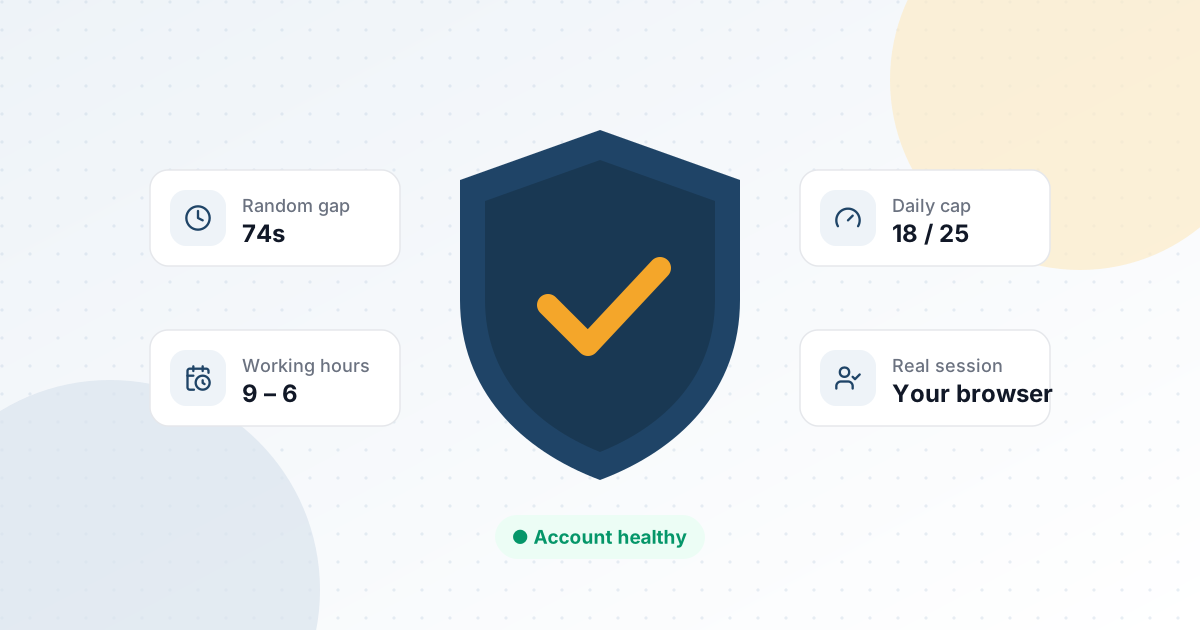
Every send is gated by rules tuned to stay well inside what a real, careful LinkedIn user would do. This is the part of HootDM we obsess over the most.
Adaptive daily caps
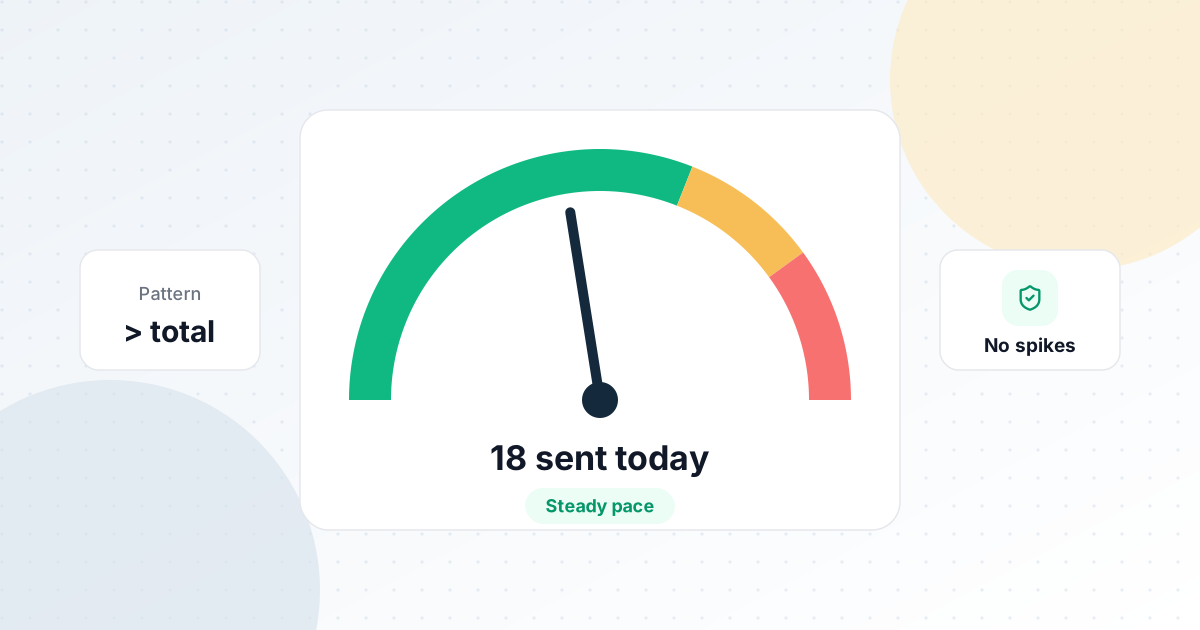
Remaining quota spreads evenly across the hours left in your day — not fired in a single burst.
Randomized jitter
60–90s of randomness on every gap — nothing fires on a suspiciously exact interval.
Per-type gaps
Likes, connections, and messages each pace independently, adapting to what's left in your window.
One shared daily budget
Run several campaigns: they share your daily limits and take turns, so your total activity never spikes.
Runs through your own session — not a headless bot
The HootDM Chrome extension is a thin relay: it carries out actions through your own logged-in LinkedIn session and reports results back. No separate browser profile, no proxy, no login credentials stored anywhere outside your own browser.
Why LinkedIn account safety matters more than raw volume
A restricted or permanently banned LinkedIn account is worth zero pipeline, no matter how much outreach it sent before that happened. Most automation tools are built to answer “how do I send more?” — HootDM is built to answer “how do I send as much as I safely can, indefinitely?” That framing changes almost every design decision underneath the product, from how delays are calculated to how many campaigns can run at once.
The four pacing mechanisms, explained
Adaptive daily caps
Rather than a fixed number of actions allowed per day, HootDM recalculates your remaining quota against the hours left in your schedule window continuously. If you’ve used less of your daily allowance by mid-afternoon, the pacing spreads what’s left more evenly across the remaining hours — instead of either front-loading everything early or leaving a stack of actions to fire all at once near the end of the day.
Randomized jitter
Every gap between actions includes a randomized offset (60–90 seconds on the base delay, and further randomization layered onto per-type gaps) seeded off your own last action timestamp. This is specifically to avoid the single easiest automation signal to detect: a fixed, mechanically exact interval between every action.
Per-type gaps
Likes, connection requests, and messages don’t share a single pacing rule — each action type has its own adaptive gap, because they carry different weight in how LinkedIn evaluates account activity. A message and a like are not the same kind of action, and treating them identically would either be too conservative on low-risk actions or too aggressive on higher-risk ones.
One daily budget per account, however many campaigns run
You can run several campaigns at the same time (2 on Starter, 5 on Pro), but they never stack. Your daily limits belong to your LinkedIn account, not to each campaign: running campaigns share them, take turns through the day, and are paced across your combined working hours. Two campaigns send the same total as one, just split between them. And a person already contacted in one campaign is skipped in the others, so nobody hears from you twice.
What HootDM does differently from headless browser tools
Some LinkedIn automation tools run your account through an isolated cloud browser or headless automation session, separate from your own device. That approach has its own trade-offs — HootDM instead runs through a lightweight Chrome extension connected to your own real, logged-in browser session. There’s no separate browser fingerprint or IP profile to manage; the actions look like they came from you, because they did, just paced and sequenced automatically.
Automation and LinkedIn’s own terms
Using any tool that automates actions on LinkedIn — including HootDM — is something to go into with eyes open: it isn’t something LinkedIn’s own User Agreement explicitly endorses, and no outreach tool, including this one, can guarantee your account will never be flagged. What HootDM can do is minimize the risk by paring activity as close as possible to how a careful, high-effort human would behave. The decision to automate outreach on your own account, and the risk that comes with it, is ultimately yours.
Common questions
Can I turn pacing off to send faster?
No — pacing, jitter, and daily caps apply to every campaign by design. There’s no setting to disable them, since that’s the entire point of the product.
What happens if I pause a campaign?
Pausing stops new actions from being claimed — pending tasks stay queued rather than being cancelled, and pick back up once you resume.
Does HootDM work with LinkedIn Sales Navigator?
HootDM works through your own LinkedIn session, using LinkedIn’s standard search and profile access. If your account has Sales Navigator, your normal LinkedIn permissions carry over, but it isn’t a requirement to use HootDM.